Section 10: The 6 Pillars of a Valid Contract
The Indian Contract Act, 1872, is the backbone of business law. But not every "deal" is a contract. If you promise your friend a pizza and then forget, they can’t sue you (hopefully!). Why? Because that wasn't a "Valid Contract." 🍕
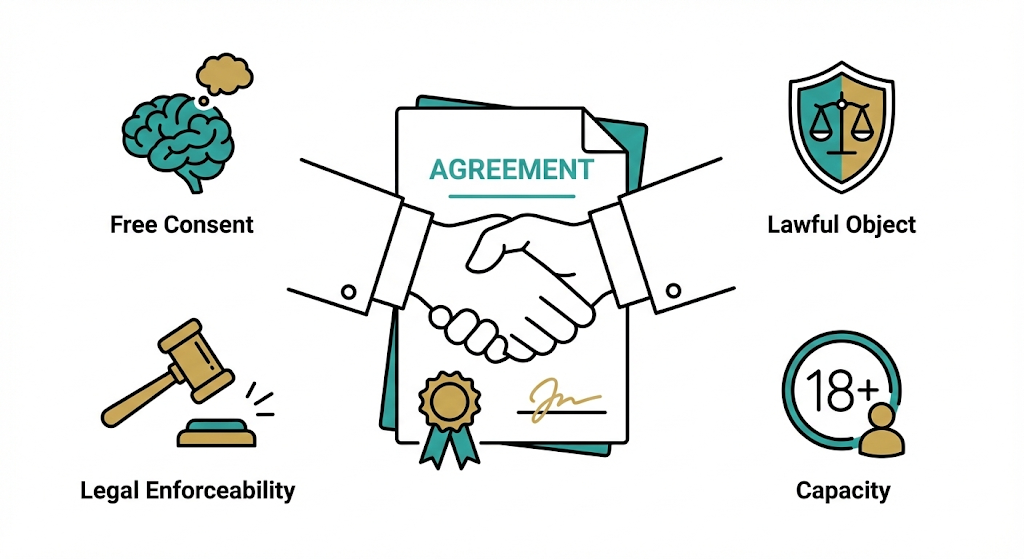
According to Section 10, for an agreement to become a legally binding contract, it must stand on these six pillars:
1. Proper Offer & Acceptance 🤝
One person says "I’ll sell this," and the other says "I’ll buy it" without any "ifs" or "buts." It must be absolute and unqualified.
2. Free Consent 🧠
This is huge. If someone points a "legal gun" at your head (coercion), tricks you (fraud), or uses their power over you (undue influence), the contract is trash. It has to be a "meeting of the minds."
3. Capacity of Parties 🔞
You can’t sign a contract with a minor, someone who is heavily intoxicated, or someone of unsound mind. They need to understand what they are signing.
4. Lawful Consideration 💰
"Quid Pro Quo"—something for something. You give the bike; they give the cash. If the "something" is illegal (like smuggling), the contract is void.
5. Lawful Object 🏦
The purpose of the deal must be legal. You can’t have a valid contract to go rob a bank together!
6. Not Declared Void 🚫
Some things are just "no-gos" by law, like agreements in restraint of trade or marriage. Such agreements appear valid but are void ab-initio.