Linear InequalitiesMCQPYQ June 19Question 1122 of 146
All Questions

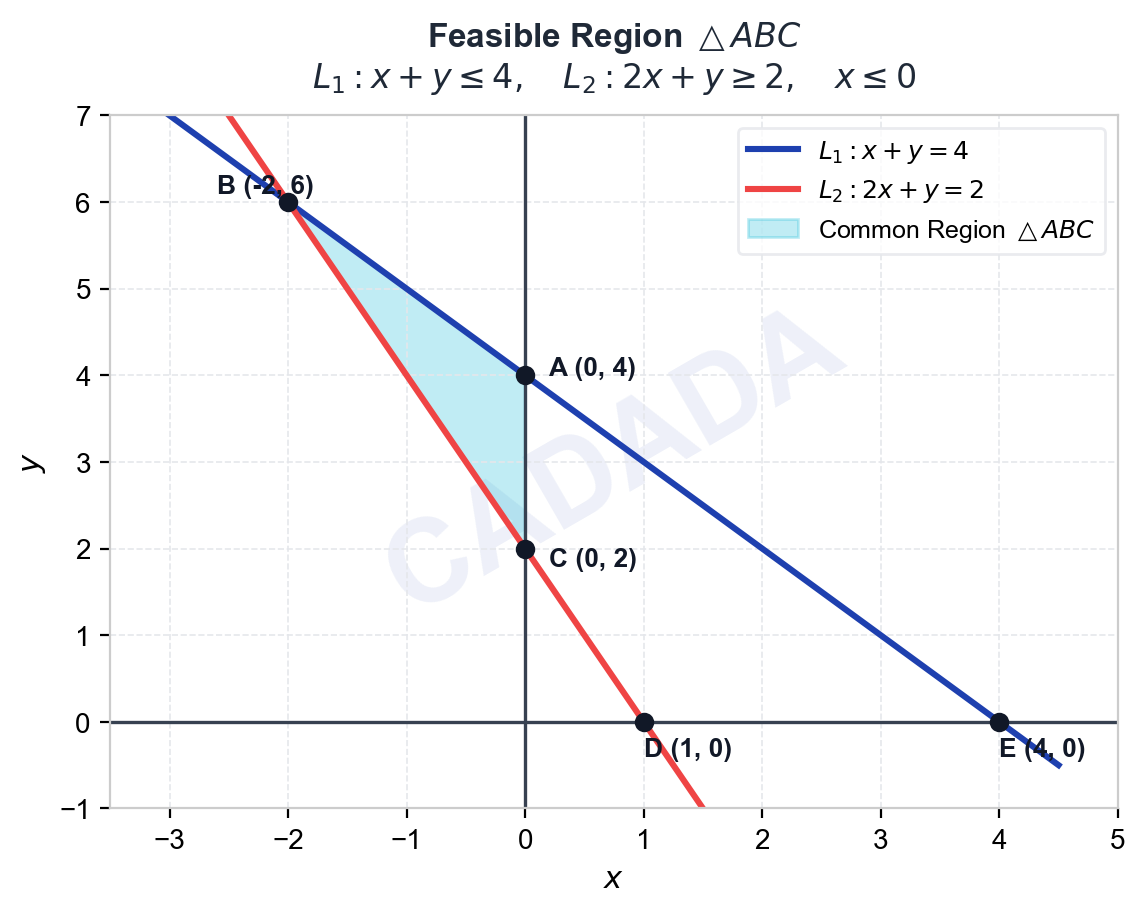
The common region represented by the following in equalities L1:x+y≤4;L2:2x+y≥2\displaystyle L_1: x + y ≤\displaystyle \le 4; L_2: 2x + y ≥\displaystyle \ge 2 is

Chapter 3 Graph

Select Your Answer (Keyboard: A, B, C, D)
For any discrepancies in this question, email contact@cadada.in

Correct Answer

✅ Option a — △ABC\displaystyle \triangle ABC

All Options:

  • A△ABC\displaystyle \triangle ABC
  • B△ABE\displaystyle \triangle ABE
  • C△ADE\displaystyle \triangle ADE
  • DOutside of OAB\displaystyle OAB

Detailed Solution & Explanation

We are given two inequalities representing lines L1\displaystyle L_1 and L2\displaystyle L_2:
1) L1:x+y≤4\displaystyle L_1: x + y ≤\displaystyle \le 4
2) L2:2x+y≥2\displaystyle L_2: 2x + y ≥\displaystyle \ge 2

**Step 1: Intercept Calculations**
- Line L1:x+y=4\displaystyle L_1: x + y = 4 has Y-intercept (0,4)\displaystyle (0, 4) and X-intercept (4,0)\displaystyle (4, 0).
- Line L2:2x+y=2\displaystyle L_2: 2x + y = 2 has Y-intercept (0,2)\displaystyle (0, 2) and X-intercept (1,0)\displaystyle (1, 0).

**Step 2: Origin Testing**
- For L1\displaystyle L_1: Substitute (0,0)\displaystyle (0,0) into x+y≤4\displaystyle x + y ≤\displaystyle \le 4:
0+0=0≤4(True)0 + 0 = 0 ≤\displaystyle \le 4 \quad (True\displaystyle \text{True})
The region lies below/left of L1\displaystyle L_1, including the origin.
- For L2\displaystyle L_2: Substitute (0,0)\displaystyle (0,0) into $2x + y ≥\displaystyle \ge 2:<br><spanclass="katex−display"><spanclass="katex"><spanclass="katex−mathml"><mathxmlns="http://www.w3.org/1998/Math/MathML"display="block"><semantics><mrow><mn>2</mn><mostretchy="false">(</mo><mn>0</mn><mostretchy="false">)</mo><mo>+</mo><mn>0</mn><mo>=</mo><mn>0</mn><mo>≥</mo><mn>2</mn><mspacewidth="1em"/><mostretchy="false">(</mo><mtext>False</mtext><mostretchy="false">)</mo></mrow><annotationencoding="application/x−tex">2(0)+0=0≥2(False)</annotation></semantics></math></span><spanclass="katex−html"aria−hidden="true"><spanclass="base"><spanclass="strut"style="height:1em;vertical−align:−0.25em;"></span><spanclass="mord">2</span><spanclass="mopen">(</span><spanclass="mord">0</span><spanclass="mclose">)</span><spanclass="mspace"style="margin−right:0.2222em;"></span><spanclass="mbin">+</span><spanclass="mspace"style="margin−right:0.2222em;"></span></span><spanclass="base"><spanclass="strut"style="height:0.6444em;"></span><spanclass="mord">0</span><spanclass="mspace"style="margin−right:0.2778em;"></span><spanclass="mrel">=</span><spanclass="mspace"style="margin−right:0.2778em;"></span></span><spanclass="base"><spanclass="strut"style="height:0.7804em;vertical−align:−0.136em;"></span><spanclass="mord">0</span><spanclass="mspace"style="margin−right:0.2778em;"></span><spanclass="mrel">≥</span><spanclass="mspace"style="margin−right:0.2778em;"></span></span><spanclass="base"><spanclass="strut"style="height:1em;vertical−align:−0.25em;"></span><spanclass="mord">2</span><spanclass="mspace"style="margin−right:1em;"></span><spanclass="mopen">(</span><spanclass="mordtext"><spanclass="mord">False</span></span><spanclass="mclose">)</span></span></span></span></span><br>Theregionliesabove/rightof\displaystyle :<br> <span class="katex-display"><span class="katex"><span class="katex-mathml"><math xmlns="http://www.w3.org/1998/Math/MathML" display="block"><semantics><mrow><mn>2</mn><mo stretchy="false">(</mo><mn>0</mn><mo stretchy="false">)</mo><mo>+</mo><mn>0</mn><mo>=</mo><mn>0</mn><mo>≥</mo><mn>2</mn><mspace width="1em"/><mo stretchy="false">(</mo><mtext>False</mtext><mo stretchy="false">)</mo></mrow><annotation encoding="application/x-tex">2(0) + 0 = 0 ≥\displaystyle \ge 2 \quad (False\displaystyle \text{False})</annotation></semantics></math></span><span class="katex-html" aria-hidden="true"><span class="base"><span class="strut" style="height:1em;vertical-align:-0.25em;"></span><span class="mord">2</span><span class="mopen">(</span><span class="mord">0</span><span class="mclose">)</span><span class="mspace" style="margin-right:0.2222em;"></span><span class="mbin">+</span><span class="mspace" style="margin-right:0.2222em;"></span></span><span class="base"><span class="strut" style="height:0.6444em;"></span><span class="mord">0</span><span class="mspace" style="margin-right:0.2778em;"></span><span class="mrel">=</span><span class="mspace" style="margin-right:0.2778em;"></span></span><span class="base"><span class="strut" style="height:0.7804em;vertical-align:-0.136em;"></span><span class="mord">0</span><span class="mspace" style="margin-right:0.2778em;"></span><span class="mrel">≥</span><span class="mspace" style="margin-right:0.2778em;"></span></span><span class="base"><span class="strut" style="height:1em;vertical-align:-0.25em;"></span><span class="mord">2</span><span class="mspace" style="margin-right:1em;"></span><span class="mopen">(</span><span class="mord text"><span class="mord">False</span></span><span class="mclose">)</span></span></span></span></span><br> The region lies above/right ofL_2,excludingtheorigin.<br><br>∗∗Step3:CommonRegionGeometry∗∗<br>Thecommonregionboundedbytheseinequalitiesinthefirstquadrantformsatriangle.Ifwelabeltheverticesofthisintersectionas\displaystyle , excluding the origin.<br><br>**Step 3: Common Region Geometry**<br>The common region bounded by these inequalities in the first quadrant forms a triangle. If we label the vertices of this intersection asA,\displaystyle ,B,and\displaystyle , andC$, the common region is represented by the triangle $\triangle ABC$.

Hence, **Option A** is the correct answer.

About This Chapter: Linear Inequalities

Paper

Paper 3: Quantitative Aptitude

Weightage

1-3 Marks

Key Topics

Linear Inequalities in one & two variables

This chapter covers Linear Inequalities in one & two variables and is part of Paper 3: Quantitative Aptitude in the CA Foundation exam.

View Official ICAI Syllabus

Exam Strategy Tip

This topic carries 1-3 Marks weightage. Focus on understanding core concepts rather than memorizing.

More Questions from Linear Inequalities

Ready to Master Linear Inequalities?

Practice all 146 questions with instant feedback, earn XP, track your streaks, and ace your CA Foundation exam.

Start Practicing — It's Free